![]() Photo: nashbaker.com |
|
Judy Pfaff |
|
|
Judy Pfaff is a pioneer of installation art and one of its most influential practitioners. Since the start of her prolific career as a sculptor, painter, printmaker, and installation artist, Pfaff has been recognized for her innovative approach to space. In the 1970s, when the dominant trend in art was “cool” in feeling and minimalist in form, Pfaff began making colorful, visually active environments that encompassed an entire gallery. Not limiting herself to a single medium, she incorporated a range of everyday and industrial materials such as wire, plastic tubing, and fabric into carefully structured installations that appeared to be spontaneous. In 2004, Pfaff was named a MacArthur Fellow and joined the illustrious roster of recipients of what is colloquially known as the “genius grant.”
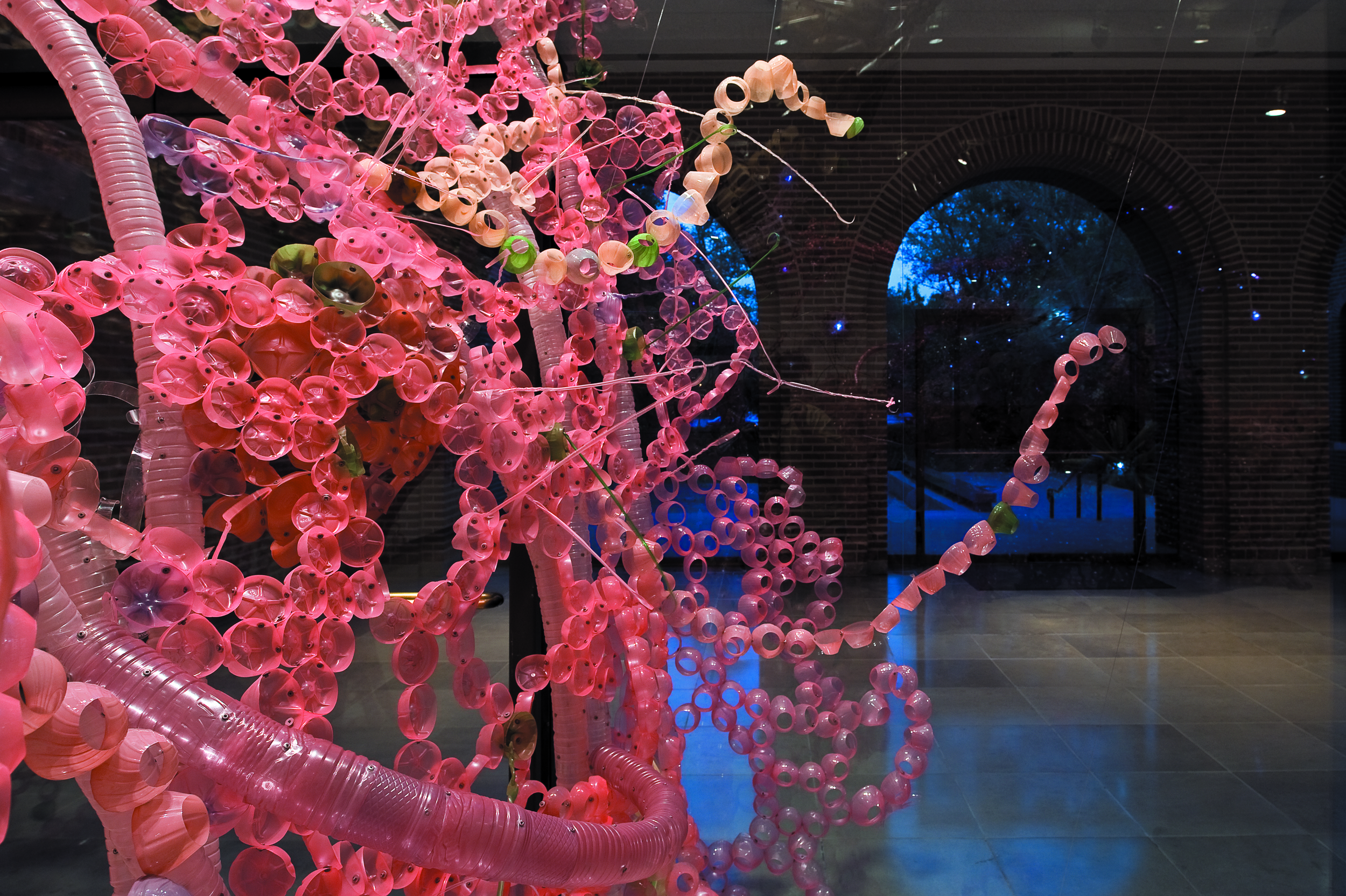
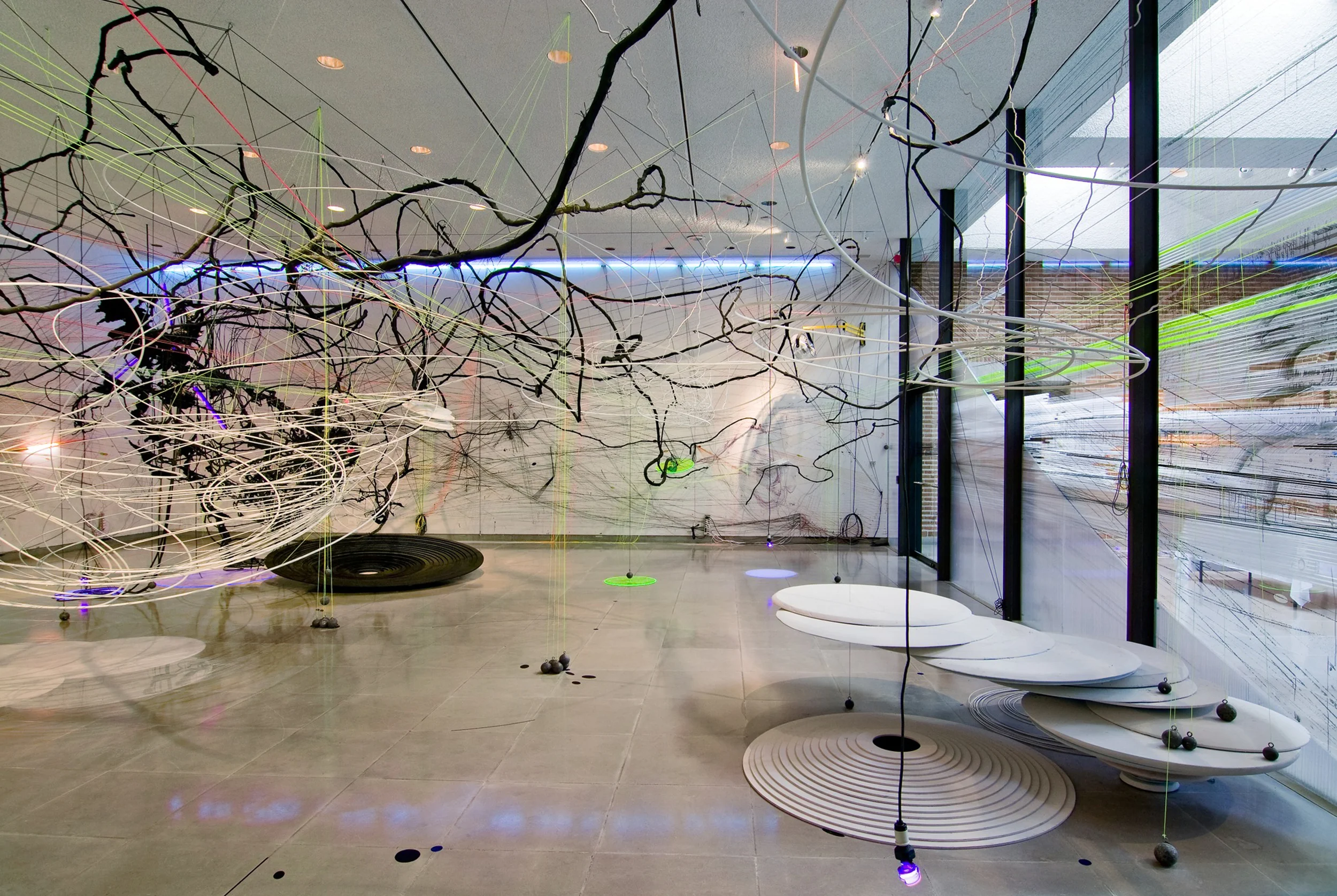
Walking into … . . all of the above is like entering a three-dimensional drawing; the gallery is filled with overlapping linear elements with a variety of materials suspended and layered in space. There is no focal point, but rather an environment to be explored and experienced. Vines, gathered from the artist’s upstate New York property and stained with dye, snake across the ceiling like lines brushed in Sumi ink. Tattered pieces of matte black foil, the sort used on photographer’s lights, cling to the vines like rotting matter. Huge white spirals of welded steel rings entwine themselves with the vines while drippy parallel lines run across the walls like an exercise in perspective drawing. To create these elegant arcing marks, Pfaff dipped rope in dye and then snapped it against the wall, a dramatic drawing gesture writ large. Yellow and orange Day-Glo string crisscrosses the room and angles to the floor. Activated by U-V light, the luminous geometry of the string contrasts with the dark meandering nature of the vines. Metal spheres cast from cannonballs hang from the ceiling like plumb bobs. On the floor different-sized circles of foam board coated with joint compound are stacked into Dr. Seuss-like towers. Pfaff’s working process is intuitive and highly physical. She addressed every aspect of Rice Gallery’s 40 foot by 44 foot space, so undaunted by scale and technical challenges that you would think she was making a diorama in a shoe box. Pfaff is used to working large; her permanent installation at the Philadelphia Convention Center,cirque, CIRQUE, is reputed to be the largest suspended sculpture in the world. Pfaff’s massive studio in upstate New York is filled with winches, welding equipment, a forklift, and pressure washers. She uses the accoutrements of a machine shop to create work that has been called “exuberant,” “lush,” “tumultuous,” and “gorgeous.” Pfaff’s art is never just about scale, and her installation isn’t simply about abstract form. Her deft but sensitive use of materials creates a wordless narrative that runs through the space. |
Judy Pfaff’s
|
|
|
|